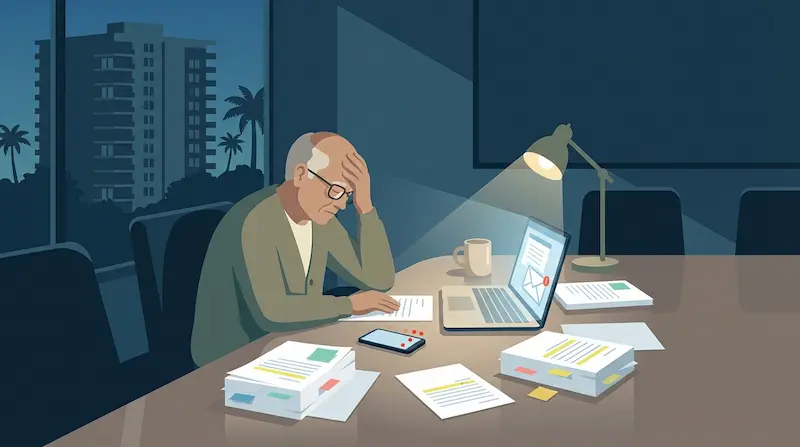
Florida has more homeowner associations than almost any state in the country — approximately 50,100 community associations governing over 9.5 million residents. Nearly all of them are run by unpaid volunteers: homeowners who raised their hand at a meeting, got elected to the board, and suddenly found themselves responsible for multimillion-dollar budgets, legal compliance, insurance negotiations, and round-the-clock resident complaints.
For decades, this model worked well enough. But in 2024, 2025, and 2026, a wave of new legislation, rising costs, and increased personal liability has pushed it to the breaking point. Boards across the state are struggling to fill seats — and the consequences for communities that can't are severe.
The numbers tell the story
Board members routinely describe the role as overwhelming — answering resident emails and phone calls, reviewing vendor proposals, coordinating maintenance, attending meetings, and digging through documents to find answers to the same questions that get asked month after month. One industry source describes board members as being expected to be "part-time legal experts, financial managers, and community diplomats — all unpaid."
All for free.
What changed in 2024–2026
The volunteer burden was already heavy. Then the Florida Legislature added more weight.
1. Criminal liability for board members
As of July 1, 2024, HB 1203 introduced criminal penalties for HOA board members. The specifics, detailed by Haber Law, include:
- Second-degree misdemeanor for knowingly and repeatedly violating records inspection requirements
- First-degree misdemeanor for intentionally destroying or failing to maintain required accounting records
- Third-degree felony for willfully refusing to produce association records to avoid detection of a crime
- Third-degree felony for knowingly soliciting or accepting kickbacks
A director charged with any of these offenses must be immediately removed from the board. For someone who signed up to help their neighbors manage the pool schedule, the prospect of criminal prosecution is a powerful deterrent.
2. Mandatory education requirements
Under Florida Statute §720.3033, newly elected board members must complete a four-hour certification course within 90 days of taking office (eight hours for communities with more than 2,500 parcels). The curriculum covers financial literacy, recordkeeping, fines, and meeting requirements. A director who doesn't file the certificate is suspended from the board until they comply. The certificate is valid for four years.
"You want me to volunteer my time, and you also want me to take a class and pass a test?" is a question many prospective board members are now asking. The answer, legally, is yes.
3. The SIRS and reserve funding mandate
Florida's Structural Integrity Reserve Study (SIRS) requirements — born from the Surfside condo collapse tragedy — now require condominium associations to fund reserves for major structural components. As of January 1, 2026, boards can no longer waive or reduce reserve contributions.
For many communities, this means delivering devastating news. Residents at The Cricket Club in North Miami received special assessments of $134,000 per unit. At Mediterranean Village in Aventura, some owners were assessed up to $400,000. The board members who deliver this news become the target of residents' anger, even though they're complying with state law.
4. The insurance crisis
Condo unit insurance premiums in Florida have risen 28.8% since 2022, and some buildings have seen spikes as high as 1,000%. While the market is now showing signs of stabilization, the damage is done — boards spent years navigating a crisis that's left many communities financially strained.
All of this compounds into a single question: why would anyone volunteer for this?

What happens when the board can't fill seats
Under Florida Statute §720.306, if no candidates run for the board, existing directors continue serving until replaced — whether they want to or not. If there aren't enough candidates, the remaining board members appoint people to fill the open seats. In practice, this means burned-out board members who are mentally checked out but legally stuck.
If the board falls below the minimum of three members, the association may need to petition the court for a receiver — a professional appointed to manage the association's affairs. Court-appointed receivers charge $150 to $300 per hour, and the cost is borne entirely by the association's members. What was free now costs the community thousands per month.
"When experienced board members walk away, they often take years of community context with them. The next board starts from scratch, not knowing where the documents are, what the vendor contracts say, or why certain decisions were made."
This institutional knowledge loss is one of the most underappreciated consequences of board turnover — and one of the hardest to solve with traditional approaches.
The real time drain: answering the same questions
Ask any board member what takes up the most time and the answer is almost always the same: resident questions.
- "Can I rent my unit on Airbnb?"
- "What are the rules about pets?"
- "When is the next assessment due?"
- "Can I paint my front door?"
- "What happened at last month's meeting?"
- "Who do I call about a leak?"
- "What does the HOA insurance cover?"
The answers to every one of these questions exist somewhere in the association's documents — bylaws, rules and regulations, meeting minutes, budgets, insurance policies, vendor contracts. But finding them means digging through hundreds of pages of PDFs, many of them scanned, some of them stored on a former board member's personal laptop.
So instead of searching, the board member answers from memory — or guesses. And when they get it wrong, the liability risk increases. When they don't respond fast enough, residents complain to the management company. When they do respond, ten more questions arrive in their inbox.
This is the cycle that burns people out. Not the governance, not the strategy, not the community leadership — the repetitive, manual information retrieval that makes board service feel like a second job.
What boards can do: practical solutions
1. Reduce the question-answering burden
The single most impactful thing a board can do to retain volunteers is to eliminate the repetitive Q&A that consumes 60–80% of their time. This doesn't mean ignoring residents — it means giving them a faster path to accurate answers.
Some boards create FAQ documents or community portals. These help, but they require manual maintenance, and residents still have to know where to look and what to search for.
A more effective approach is an AI-powered document assistant. Mosaic, for example, ingests all of an association's documents — bylaws, budgets, meeting minutes, insurance policies, rules and regulations — and lets residents ask questions in plain language. The AI searches across every document and returns a sourced answer with citations in seconds, 24/7. It also has Florida Statutes Chapter 718 and Chapter 720 built in, so it can cross-reference community rules with state law.
At $199 per month — a fraction of what a management company charges — it's the equivalent of adding a full-time employee who never takes a day off and knows every document the association has ever filed.
Try Mosaic alongside your current software. No Risk!
- Keep yourself compliant on every statute change
- Keep your board compliant across every workflow
- Keep your HOA compliant and your owners happy
2. Distribute the workload
Boards that rely on one or two people to handle everything are fragile. Creating committees — architectural review, finance, landscaping, communications — distributes responsibility across more residents without requiring them to serve on the board itself. Committee members contribute a few hours a month rather than 15 hours a week, and they build the experience needed to eventually step into board roles.
3. Set term limits and succession plans
Florida law doesn't require term limits, but boards that implement them avoid the holdover director trap. Staggered two-year terms ensure that at least half the board has continuity at any given time, while preventing any one person from serving indefinitely out of obligation rather than desire.
4. Make meetings efficient
Nothing drives volunteers away faster than three-hour meetings that could have been handled in 45 minutes. Boards that adopt strict agendas, time limits for open discussion, and virtual meeting options (now explicitly authorized under Florida law) see better retention. If residents can attend virtually, more people participate — which also increases the pool of potential future board candidates.
5. Acknowledge the work publicly
Board members receive no financial compensation. The least a community can do is acknowledge their contributions. A note in the newsletter, recognition at the annual meeting, or a simple thank-you email from residents goes further than most people realize. Burnout accelerates when effort feels invisible.
The bigger picture: is the volunteer model sustainable?
Florida legislators are asking this question too. In March 2026, HB 657 was signed into law — a sweeping reform bill that, among other things, allows homeowners to dissolve their HOA entirely with a two-thirds supermajority vote, effective July 1, 2026. The bill also creates a dedicated Community Association Court for disputes. One state representative described HOAs as a "failed experiment" on the House floor.
The fact that this bill became law reflects a broader reality: communities built on volunteer governance are reaching a point where the demands exceed what unpaid people can reasonably be expected to handle.
The communities that will thrive are the ones that recognize this shift early and invest in tools, processes, and infrastructure that make volunteer service manageable — not heroic.
Key takeaways
- The volunteer crisis is real and accelerating. New criminal liability, mandatory education, SIRS compliance, and insurance costs have compounded the burden on unpaid board members.
- The biggest time drain is answering repetitive questions. Boards that eliminate this burden — through AI-powered document search, FAQ portals, or better communication tools — retain volunteers longer.
- Failing to fill the board has real financial consequences. Court-appointed receivers cost communities thousands per month. Knowledge loss from turnover creates compliance risk.
- Structural solutions matter more than motivation. Committees, term limits, efficient meetings, and technology reduce the per-person workload — which is the root cause of burnout.
- Florida's legislative environment is only getting more demanding. Boards that don't adapt their operations will continue to lose the people who make those operations possible.
Frequently Asked Questions
Share this guide