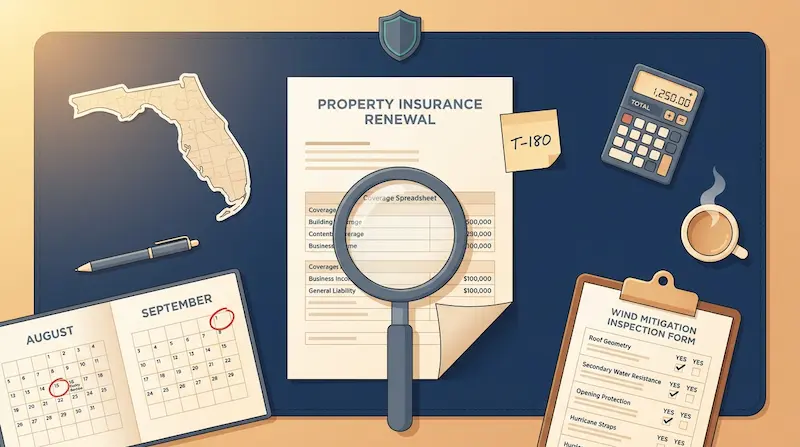
For Florida HOA and condo boards, the 2026 renewal cycle is not a price negotiation — it is a warrantability decision, a compliance audit, and a deductible-math problem rolled into one. Three regulatory cliff dates have moved into binding force in the last five months and shape every renewal decision a Florida board will make this summer. Hurricane Helene and Hurricane Milton stress-tested the post-2022 reform package, the reinsurance market is finally softening at the June 2026 treaty renewals, and Citizens Property Insurance has shrunk to its smallest book since 2002. None of that helps a board that misses the 36-month appraisal rule, walks past the new Fannie Mae per-unit deductible cap, or arrives at renewal with one quote in hand.
This guide walks the operational and legal framework of a Florida HOA or condominium master-policy renewal — the statutory requirements, the lender rules, the 180-day timeline, the broker RFP, the line-by-line coverage review, and the negotiation tactics that actually move premium in this market. Pair it with our Florida HOA hurricane season checklist for the operational counterpart, our SIRS reserve funding guide for the structural-reserves intersection, and our HOA loans guide for the post-loss financing mechanics.
This article is general information for Florida HOA and condo boards and CAMs, not legal, insurance, or tax advice. Florida insurance statutes and regulatory guidance are amended frequently — verify any specific subsection at flsenate.gov, floir.gov, or citizensfla.com before relying on it. Consult a licensed Florida community-association attorney and a CIRMS-credentialed broker for guidance on your association's specific situation.
The three 2026 cliff dates
Three regulatory deadlines drive almost every renewal-cycle decision a Florida board will make this summer. Miss any of them and the consequences cascade into coverage, premium, warrantability, or legal exposure for the board personally.
Dec 31, 2025 — first SIRS deadline (passed)
- All owner-controlled condos existing on or before July 1, 2022, with three or more habitable stories
- HB 913 extended only those coordinated with milestone inspections to Dec 31, 2026
- Citizens is statutorily barred from issuing or renewing for non-compliant associations
- Carriers ask about reserve adequacy and may surcharge or decline demonstrably underfunded associations
April 1, 2026 — new wind mitigation form
- OIR-B1-1802 Rev. 04/26 mandatory for all NEW inspections on or after April 1, 2026
- Prior Rev. 01/12 form grandfathered if the inspection was completed before April 1, 2026 AND is within 5 years of the policy effective date
- Mitigation credits can shift up or down under the new form
- Get a fresh inspection if your form is older than 5 years or the building has been re-roofed
July 1, 2026 — Fannie Mae $50K cap
- Lender Letter LL-2026-03 mandatory effective date
- Master-policy per-unit deductible cannot exceed $50,000 on any required peril
- Above the cap, the project becomes non-warrantable
- Conventional 30-year mortgages on units become unavailable
- Resale values can drop 10 to 25 percent within months
Jan 4, 2027 — reserve funding minimum
- Fannie Mae increases the reserve funding minimum from 10 to 15 percent of annual budgeted assessment income
- Build it into the FY 2027 budget cycle now
- Baseline funding method retires Aug 3, 2026 — threshold or fully-funded only
- Limited Review retires Aug 3, 2026 — Full Review or waiver only for established projects
Each of these is documented at the source — Fannie Mae LL-2026-03, the HB 913 enrolled text, and the Florida Office of Insurance Regulation for the wind-mitigation form. Boards that walk into a renewal meeting unaware of these dates are walking into a fiduciary problem.
The 180-day renewal timeline
Florida's market punishes late submissions. Build the calendar back from the policy expiration date and treat each milestone as a board-approved deliverable, not a wish.

T-180 days — get the house in order
- Pull 5-year loss runs from the current and any prior carrier. Loss runs are the single biggest underwriting input.
- Order a pre-loss property condition report — roof, plumbing, electrical, life-safety, exterior. This is the evidence package against under-insurance disputes.
- Verify mitigation features on file are still valid; if anything has been replaced (roof, openings, straps), order a fresh OIR-B1-1802 Rev. 04/26 inspection.
- Confirm renewal date and notice provisions in the current declarations page — some carriers require 60 to 90 days' notice of non-renewal.
- Board appoints an Insurance Committee — typically the treasurer plus one or two directors plus the CAM — to own the file.
T-150 days — broker decision
- Decide whether to retain the incumbent broker or run an RFP. Industry guidance from FCAP and CAI is to begin working with the agent at least 150 days before renewal because of how slow the Florida market has become.
- If running an RFP, issue it now. See the RFP section below.
- Hold a market-direction call: are admitted carriers writing this risk class, or does it have to go to surplus lines? Are layered programs above a primary limit required? This call sets owner expectations.
T-120 days — submission package finalized
- Final broker selected. Sign the broker-of-record letter so they can market exclusively. Avoid letting two brokers shop the same carriers — underwriters will block both submissions.
- Submission package complete: loss runs, current declarations, replacement-cost appraisal, SIRS report, milestone inspection report (condos 30+ years old, 25+ years coastal), wind mitigation inspection, photo set, schedule of values, board and management information, coverage targets.
- Begin marketing to admitted carriers, then surplus lines.
T-90 days — compliance triggers
- Refresh the 36-month appraisal if it has expired or will expire before bind. FS 718.111(11) requires an independent appraisal at least every 36 months. Carriers in 2025-2026 are strictly enforcing this rule. Appraisals take 2 to 4 weeks.
- Reserve study and SIRS check (condos). HB 1021 and HB 913 require reserves for SIRS components to be funded; carriers ask about reserve adequacy.
- Milestone inspection results uploaded to the submission file. FS 553.899 requires inspection at 30 years, with a discretionary 25-year trigger when the local building official determines proximity to salt water warrants it (HB 1021 in 2024 replaced the prior fixed 3-mile-of-coast rule with this discretionary standard).
T-60 days — quotes in hand
- Receive bound or indication quotes from at least three markets.
- Build the side-by-side coverage spreadsheet. See the coverage section below for what to compare.
- Broker presents to the Insurance Committee. Committee selects two or three finalists for the full board.
T-30 days — board approval and member notice
- Open board meeting with insurance on the agenda. Condo associations with 25 or more units must post the agenda and supporting documents on the official website per HB 1021 effective Jan 1, 2026.
- Board votes to bind. Minutes record the carriers solicited, the quotes received, and the basis for selection. This builds the documented best-efforts record.
- Notice to owners with the new premium, deductible, and any special assessment needed. Early disclosure beats surprise.
T-14 days and bind day
- Subjectivities cleared — signed applications, premium financing if used, TRIA elections, agreed-value or replacement-cost endorsement signed.
- Premium-finance agreement executed if cash-flowing the premium.
- Binders issued. Get evidence of property (ACORD 28) and evidence of liability (ACORD 25) in hand.
- COI distribution to mortgagees and lenders begins immediately. Many require electronic delivery within 30 days or they force-place coverage at owner expense.
Statutory coverage requirements
Five Florida statutes govern almost every coverage decision a board makes at renewal. Get these wrong and the lawsuits follow.
FS 718.111(11) — condominium master policy mandate
The foundational statute for condos. Every condominium association must have adequate property insurance based on the replacement cost of the property as determined by an independent insurance appraisal. The replacement cost must be determined at least once every 36 months. Coverage must cover all portions of the condominium property as originally installed or replacement of like kind and quality, plus alterations made under FS 718.113(2).
The statute defines what coverage must exclude — personal property within the unit, floor and wall and ceiling coverings, electrical fixtures, appliances, water heaters, water filters, built-in cabinets and countertops, and window treatments. Those items are the unit owner's responsibility under their HO-6 policy. The "originally installed" line is one of the most-litigated boundaries in Florida community-association law and the source of most master-versus-owner claim disputes after a loss.
Section 11(h) requires fidelity bonding for every person who controls or disburses association funds, in an amount equal to the maximum funds in the custody of the association or its management agent at any one time. There is no statutory dollar minimum — the maximum-funds-in-custody figure governs. HB 913 effective July 1, 2025 layered additional appraisal-currency requirements onto the same statute and broadened condo emergency powers.
FS 720.303 — HOA fiduciary duty
HOAs governed by Chapter 720 do not have a statutory replacement-cost mandate at the same specificity as condos. Insurance adequacy for an HOA is a fiduciary obligation under FS 720.303(1), which incorporates the not-for-profit fiduciary standard of FS 617.0830, and is enforceable through derivative action. Most well-governed HOAs voluntarily follow the condo standard — replacement-cost coverage, periodic appraisal, fidelity bonding for fund custodians.
FS 627.714 — owner loss-assessment minimum
Every Florida condominium unit owner's residential property policy must include at least $2,000 in property loss-assessment coverage for assessments arising from the same direct loss to the property, with a deductible of no more than $250 per loss. The unit owner's policy is excess over any other policy covering the same property. The $2,000 statutory minimum is dramatically inadequate post-Surfside — brokers routinely recommend $25,000 to $50,000 or more, particularly in buildings with five-figure-per-unit master deductibles.
FS 627.701 — hurricane deductible disclosure
Every Florida policy with a separate hurricane deductible must include on its face, in boldfaced type no smaller than 18 points: "THIS POLICY CONTAINS A SEPARATE DEDUCTIBLE FOR HURRICANE LOSSES, WHICH MAY RESULT IN HIGH OUT-OF-POCKET EXPENSES TO YOU." The hurricane deductible applies on a calendar-year basis. If a prior hurricane loss in the same calendar year burned through the deductible, a subsequent hurricane is paid from dollar one — subject to the all-other-perils deductible. The bold-type disclosure must be on the declarations page; if it is missing, the policy form may not be enforceable as written.
FS 627.4025 — definition of "hurricane"
The Florida Statutes define a hurricane as a storm system declared a hurricane by the National Hurricane Center, with the duration covering the time period from when an NHC hurricane warning is issued for any part of Florida through 72 hours after the last NHC hurricane watch or warning is terminated. Losses outside that window are paid under the all-other-perils deductible (much smaller), not the hurricane deductible. For a Florida condo, getting the timing right matters in claim filing — wind damage on either edge of the official window can be the difference between a $25,000 deductible and a $750,000 deductible.
Fannie Mae and Freddie Mac warrantability
Lender warrantability is the silent killer of Florida HOA and condo renewals. If the master policy fails Fannie Mae or Freddie Mac project standards, units lose conventional 30-year mortgage availability. Sales fall through. Refinances stall. Valuations drop. Owners cannot move. Boards lose warrantability silently and find out only when a closing collapses.

Fannie Mae LL-2026-03 — what changed
Issued March 18, 2026. Lenders may use the new rules immediately; mandatory effective dates phase in through 2027.
- $50,000 per-unit master-policy deductible cap. Mandatory July 1, 2026, applies to all required perils including wind. Above the cap, the project becomes non-warrantable.
- Reserve funding minimum 10 percent → 15 percent of annual budgeted assessment income OR funding to the highest level in a current reserve study. Mandatory January 4, 2027.
- Baseline funding method retired August 3, 2026. Threshold or fully-funded methods only thereafter.
- Limited Review retired August 3, 2026 for established projects. Full Review or Waiver of Project Review only.
- ACV roof option restored on the master policy. LL-2026-03 retired the prior requirement that master policies insure roofs on a replacement-cost basis. Master policies may now insure roofs on actual-cash-value basis. The non-roof structure on the master still requires replacement-cost coverage at 100 percent.
- Inflation guard requirement retired. One less moving piece in the master deductible math.
- Project review waivers expanded to projects with 10 or fewer units (provided the project is not part of a master association or larger development).
The deductible math
The $50,000 per-unit cap is the bite. Florida coastal towers with 5 percent wind deductibles routinely exceed it on smaller buildings.
| Building | Insured value | Wind deductible % | Total deductible | Per-unit ÷ unit count | Warrantable? |
|---|---|---|---|---|---|
| 30 units, mid-rise | $15M | 5% | $750K | $25,000 | Yes (under $50K) |
| 30 units, mid-rise | $20M | 5% | $1M | $33,333 | Yes |
| 30 units, mid-rise | $30M | 5% | $1.5M | $50,000 | At the cap |
| 30 units, mid-rise | $40M | 5% | $2M | $66,667 | No |
| 100 units, high-rise | $50M | 5% | $2.5M | $25,000 | Yes |
| 100 units, high-rise | $100M | 5% | $5M | $50,000 | At the cap |
| 20 units, oceanfront | $30M | 5% | $1.5M | $75,000 | No |
| 20 units, oceanfront | $30M | 3% | $900K | $45,000 | Yes |
Boards with 5-percent-of-TIV wind deductibles on small-unit-count coastal buildings face a binary choice before the July 1, 2026 deadline: buy down the deductible (premium spike) or lose Fannie Mae eligibility (financing freezes for every unit). A deductible buy-back or buy-down policy is explicitly permitted under Fannie Mae Selling Guide B7-3-03 to satisfy the cap. Pricing on those buy-down policies is not in the public record — boards facing the cliff need to pull a quote from the broker before assuming it is affordable.
Freddie Mac, FHA, and VA
Freddie Mac Bulletin 2026-C mirrors the Fannie Mae changes, including the $50,000 per-unit deductible cap and reserve funding increases. FHA requires master hazard at 100 percent replacement cost, general liability, fidelity bonding for projects with 20 or more units (3 months aggregate assessments plus reserve funds), and flood insurance for any structure in a Special Flood Hazard Area. VA coverage rules under Lender's Handbook M26-7 require master hazard at 100 percent replacement cost, $1 million minimum general liability per occurrence, fidelity bond on the same FHA formula, and flood certification.
Master policy line items
Force the broker to walk you through every line of the policy, not just the headline premium. Every coverage section below should be on the side-by-side comparison spreadsheet for every quote.
| Coverage | What it does | Renewal questions to ask |
|---|---|---|
| Coverage A — Building | Structural building, common elements, "originally installed" interior items | What is the appraisal-based replacement cost? When was the last appraisal? Does it satisfy FS 718.111(11)? |
| Coverage B — Other Structures | Detached structures: pool cabanas, gatehouses, sea walls, signage | What is the sublimit? Are sea walls and gates explicitly included or excluded? |
| Wind / Named-storm | Hurricane, tornado, gusts during NHC-declared windows | What is the per-unit deductible math? Does it exceed the $50K Fannie cap on July 1, 2026? |
| Flood (NFIP RCBAP + private excess) | Storm surge, rising water, mudflow — separate from wind | Is the RCBAP at 80%+ of replacement value? What is the private excess attachment point? |
| Ordinance and Law A/B/C | Code-mandated upgrades during reconstruction | What percentage of Coverage A is C? Aim for 25-50% on older buildings. |
| Loss of Use / ALE / Business Income | Lost rents, displaced offices, fair-rental-value reimbursement | How many months? Does it include owner rental income? What is the waiting period? |
| Equipment Breakdown | Internal mechanical/electrical failure: elevators, chillers, generators | Are elevators, generators, fire pumps, access systems all named in schedule? |
| General Liability | Slip-and-falls, pool drownings, dog attacks in common areas | $1M/$2M minimum (VA explicit). Does aggregate reset annually? |
| Umbrella / Excess | Pays above primary GL, hired auto, EBL, sometimes D&O | $5M-$25M typical. Does it drop down for D&O or only sit excess? |
| Directors and Officers | Wrongful acts, breach of fiduciary duty, mismanagement claims | Defense costs inside or outside the limit? Eroding-limit policy? Failure-to-maintain coverage included? HB 913 emergency-powers endorsement? |
| Employment Practices Liability | Wrongful termination, discrimination, harassment | Required if any direct-pay help. Third-party EPLI for resident discrimination claims? |
| Cyber Liability | Breach response, ransomware, social-engineering fraud | What is the social-engineering sub-limit (often $50K — push to $250K)? |
| Crime / Fidelity | Employee/board theft, forgery, computer fraud | Does it meet FS 718.111(11)(h)? Is the management company specifically named as covered? |
| Hired and Non-Owned Auto | Liability when board members or volunteers drive on association business | Matches GL limits? Most masters carry it as endorsement. |
| Pollution / Environmental | Pool chemical release, fuel-tank leak, mold remediation | Is mold remediation post-water-loss covered or excluded from both property and pollution forms? |
| Workers Compensation | Required if any direct W-2 employees | "If any" policy or active payroll? Volunteers covered? |
| Terrorism / TRIA | Federally backstopped through TRIA reauthorization | TRIA accepted or rejected, with rejection in writing? |
For the broader operational view of how these coverages interact during a hurricane response, pair this with our Florida hurricane season checklist. For the underlying financial discipline that supports renewal preparation, see our HOA financial evaluation guide and our HOA banking needs guide.
Try Mosaic alongside your current software. No Risk!
- Keep yourself compliant on every statute change
- Keep your board compliant across every workflow
- Keep your HOA compliant and your owners happy
Common gaps that hurt boards
- Stale appraisal — coinsurance penalty triggers on partial losses; carrier pays only carried/required ratio. The 36-month FS 718.111(11) clock is now strictly enforced before binding.
- Wind deductible math — 5 percent of insured value on $40M is $2M out of pocket. If the per-unit calculation exceeds $50,000, the project becomes non-warrantable July 1, 2026.
- Missing or inadequate Ordinance and Law — code-mandated upgrades during reconstruction (impact glazing, sprinklers, structural retrofits) are uncovered above the small default sublimit. Default O&L Coverage C is often only 10 percent of A; aim for 25 to 50 percent for older buildings.
- D&O without defense-cost clarity — eroding-limit policies can leave nothing for settlement after a 2-year defense. Negotiate defense outside the limit or buy non-eroding endorsement.
- No emergency-powers endorsement on D&O — HB 913 broadened condo emergency powers; D&O coverage of board acts under FS 718.1265 or FS 720.316 should be confirmed in writing by endorsement.
- Storm surge confused for wind — surge is flood, not wind. NFIP RCBAP and private excess flood, not the property policy, pay for it. Most-litigated claim-denial pattern post-Helene.
- Cyber omitted entirely — Florida HOAs store owner SSNs, banking info, voting platforms. Wire-fraud is the most common claim; social-engineering sub-limit defaults are often $50,000.
- Crime bond doesn't name the management company — treasurer bonded, property manager handling funds is not. Add named-insured endorsement.
The broker RFP
The broker selection itself is a fiduciary decision. Boards should solicit competing proposals from at least three brokers, verify their carrier appointments, require written disclosure of all forms of compensation, and check three references with similar Florida associations.
Credentials to require
- CIRMS — Community Insurance and Risk Management Specialist. The CAI specialty designation requires five-plus years in the community-association insurance space, code-of-ethics compliance, and continuing education. The gold-standard credential.
- CISR or CISR-Elite — Certified Insurance Service Representative; broader P&C credential. Useful but not community-association specific.
- FAPIA membership or working relationships — the Florida Association of Public Insurance Adjusters connects brokers to claim-side advocacy.
- FAIA membership — Florida Association of Insurance Agents; signals general-market access.
- Errors and Omissions coverage — minimum $5 million on the agency.
National vs regional vs local brokers
National brokerages
- Deepest carrier sheet, layered/excess capacity, captives, dedicated community-association practice groups
- Larger accounts get attention; small associations can be neglected
- Rule of thumb: over $25M TIV or within 5 miles of coast — national or top-tier regional
Regional Florida specialists
- Florida-specific market knowledge, established Citizens and FL surplus relationships
- Hurricane claims expertise
- Sweet spot for mid-size associations
- Thinner non-cat / liability markets sometimes
Sample RFP outline
- 1. Executive summary of the association — units, age, TIV, distance to coast, claims posture
- 2. Scope of services — marketing, placement, mid-term certificates, claims advocacy, board-meeting attendance, annual stewardship report
- 3. Carrier access — every admitted, non-admitted, and surplus-lines market the broker is currently appointed with
- 4. Compensation model — commission, fee, or hybrid; full schedule including overrides, contingents, and bonus commissions
- 5. Team — named producer, account executive, claims advocate with credentials
- 6. References — three Florida community associations of comparable size and geography, clients for at least 24 months, direct phone numbers
- 7. E&O coverage — minimum $5 million on the agency
- 8. Sample stewardship report from a current client (redacted)
- 9. Conflicts disclosure — any ownership or contingent-commission relationships with the carriers being recommended
- 10. Service-level agreements — binders, COIs, claim acknowledgment timing
Negotiation tactics that work
The market in 2026 is hard but no longer impossible. Tactics that actually move premium for Florida HOA and condo masters:
- Layered programs. Above $25 million in total insured value, a single-carrier solution is often unavailable or brutally expensive. Build a primary layer plus excess from multiple carriers so no single underwriter takes the whole risk.
- Deductible buy-back or buy-down policies. When the master deductible exceeds the new $50,000 per-unit Fannie cap, a buy-back policy can buy it down to compliance on a separate policy meeting the same insurer-rating requirements.
- Restructure wind separately. Wind-only or named-storm-only placement (often Citizens or a surplus-lines wind market) plus an all-other-perils policy with a different carrier sometimes beats a packaged quote. Requires coordinated claims protocol.
- Trade premium for higher AOP deductible. Going from $10,000 to $25,000 or $50,000 all-other-perils deductible rarely surfaces at claim time and can save 5 to 15 percent of premium.
- Mitigation re-certification. If the OIR-B1-1802 has expired or wasn't fully credited, getting a current Rev. 04/26 inspection and re-pricing is the highest-ROI lever. Wind-mitigation credits can run 20 to 50 percent off the wind premium for fully-credited buildings.
- Loss-control commitments. Offer the carrier a binding loss-control plan — water-leak sensors, infrared roof scan, sewer-line inspection — for additional credit.
- Multi-year quote requests. Some surplus markets will offer a 5 to 7 percent reduction in exchange for a 2-year rate guarantee with limited cancellation rights.
- When to walk to surplus lines. If admitted carriers are quoting more than 25 percent above last year despite a clean loss run, or are excluding wind or capping water below historical exposure, surplus lines is mainstream for Florida coastal condos in 2026.
The 2025 amendments under HB 393 expanded eligibility and dropped the unit-owner approval threshold from 100 to 75 percent, with up to $175,000 per association in matching grants for hurricane-hardening on three-story-plus condo buildings within 15 miles of the coast. As of this writing, the legislature has not appropriated new funds for the program in 2025, and most 2024 grant applicants have not yet received funds because most have not progressed to the payment stage. Boards counting on My Safe Florida Condominium grants for 2026 mitigation upgrades pre-renewal should confirm current funding status with the program directly at mysafeflcondo.com before relying on it.
Member communication
Premium increases produce more board controversy than any other line item. Lead the conversation; do not follow it.
- Send a pre-meeting memo 14 to 21 days before the board meeting summarizing the carriers marketed, the percentage increase versus market average, the mitigation credits captured, and the deductible chosen
- Frame the increase against the market — Florida average all-perils premium reached $3,023 in Q1 2025, a 34 percent increase from Q4 2022, per Insurance Journal. Citizens approved a 14.2 percent statewide condo rate increase for 2025. If the association came in at single-digit, that is a win — say so
- Show the per-unit and per-month impact, not just the aggregate dollar increase
- Be explicit if a special assessment is needed and tie it to SIRS reserve obligations now in effect under HB 913
- Owner self-help: encourage HO-6 review with loss-assessment coverage matching the master deductible plus a buffer (push owners from the $2,000 statutory minimum to $25,000-$50,000)
The annual financial report disclosure obligations under FS 718.111(13) (condo) and FS 720.303(7) (HOA) require insurance premiums to be reported. HB 1021 effective January 1, 2026 requires condo associations with 25 or more units to publish governing documents, budgets, financial reports, and meeting minutes/agendas on a member-accessible website — the insurance binder, declarations, and renewal-meeting minutes belong there.
Common mistakes and after-bind workflow
Eight mistakes that blow up renewals
- Letting the 36-month appraisal lapse — coinsurance penalty + carriers refusing to bind
- Going to renewal with one quote — fails the documented best-efforts standard
- Letting the broker pick the deductible without board input — deductibles are reserve and cash-flow decisions that belong to the board
- Missing the OIR-B1-1802 Rev. 04/26 mitigation-credit window — locks in a year of higher rates
- Ignoring lender warrantability — non-compliant deductible or ACV roof endorsement disqualifies units from Fannie Mae and Freddie Mac financing the day after bind
- Not budgeting the renewal — boards routinely surprised by the increase. Build the broker's renewal indication into the FY operating budget by Q3 of the prior year
- Filing small claims that scar the loss runs — anything within 25 percent of the deductible deserves a written cost-benefit before going to FNOL
- Skipping the SIRS and reserve linkage — underfunded reserves are now a known underwriting question post-HB 1021. Carriers ask, and demonstrably underfunded associations may see surcharges or non-renewal
After-bind workflow
The post-bind 30 days are when warrantability and lender problems surface. Do not relax on bind day.
- Distribute COIs to every mortgagee on file. Most servicers now use central portals (Proctor, ISN, Insurance Tracking Center). Send within 7 days; lenders that don't get a renewal COI within 30 days force-place coverage at owner expense
- Update governing-document references if coverage architecture changed — the declaration may reference specific deductible language and may need an amendment
- File the policy in the records system. For condo 25+ unit associations, post to the website per HB 1021
- Send owner notice of renewal with new declarations summary and HO-6 review checklist
- Calendar T-180 for next year. This single step converts the next renewal from a fire drill into a process
- Quarterly stewardship review with the broker — open claims, mid-term audit, new mitigation work, schedule-of-values updates
For the bigger framework around financial readiness that supports a clean renewal, pair this with our HOA balance sheet guide, our Florida condo milestone inspection guide, and our audit preparation guide. Nolo's HOA legal encyclopedia, the Florida Bar consumer pamphlet, and ongoing commentary from Becker, Kaye Bender Rembaum, and KSN Law are useful third-party references for boards working through the new statutory framework.
Frequently asked questions
180 days before the policy expires. Pull 5-year loss runs at T-180, decide on broker by T-150, finalize the submission package by T-120, refresh the 36-month appraisal if needed by T-90, receive quotes by T-60, board vote and member notice by T-30, bind at T-0. Florida's hardened market in 2025-2026 punishes late submissions with worse pricing or non-renewal entirely. Carriers regularly reject incomplete files within days, and once rejected your broker has to re-approach the same underwriter later in the cycle, usually with worse terms.
Effective July 1, 2026, Fannie Mae Lender Letter LL-2026-03 sets a maximum per-unit deductible of $50,000 on master property insurance policies for all required perils. If the master policy exceeds it, the project loses warrantability. Conventional 30-year mortgages on units become unavailable, refinances stall, and resale values can drop 10 to 25 percent. A 5 percent wind deductible on a 30-unit, $20 million Florida coastal building works out to roughly $33,000 per unit and is fine. The same building at $30 million insured value reaches the cap. Boards must verify the per-unit math with the broker before binding.
Yes. Florida Statute 718.111(11)(a) requires every condominium association to determine the replacement cost of insured property by independent insurance appraisal, with the appraisal updated at least once every 36 months. Carriers in 2025 and 2026 are strictly enforcing the rule and will not bind without a current appraisal on file. An expired appraisal triggers a coinsurance penalty at claim time, where the carrier pays only the ratio of carried versus required coverage. HB 913, effective July 1, 2025, layered additional appraisal-currency expectations onto the same statute. HOAs governed by Chapter 720 do not have an equivalent dollar-replacement-cost mandate but the board's fiduciary duty under FS 720.303 typically drives the same practice.
Generally not for commercial residential. Florida's 20-percent rule makes a Citizens policyholder ineligible to remain at Citizens when a private-market offer comes in within 20 percent of the Citizens premium. The rule applies to both personal residential and commercial residential, but personal residential policyholders have the Policyholder Choice election allowing them to remain at Citizens when a private offer exceeds 20 percent of the Citizens premium. Commercial residential historically has had a more constrained election path. The procedural rules are set in statute, OIR orders, and Citizens depopulation bulletins, and they have evolved. Boards receiving a takeout offer in 2026 should confirm the current rule with the broker and the Citizens depopulation portal before assuming they can decline.
Almost always a broker, and a broker with the CIRMS designation from Community Associations Institute. Florida HOA and condo master policies sit at the intersection of admitted carriers, surplus lines, Citizens, and lender warrantability rules — a depth of specialty that direct-to-carrier purchases cannot match. Boards should solicit competing proposals from at least three brokers with comparable specifications, verify their carrier appointments, require written disclosure of all forms of compensation, and check three references with similar Florida associations. The broker selection itself is a fiduciary decision under the documented best-efforts standard FS 718.111(11) implies and FS 720.303 imposes generally.
Share this guide
