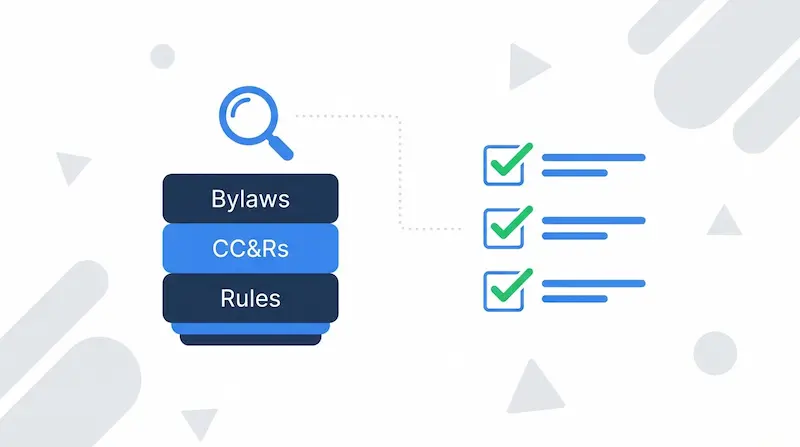
If you serve on a Florida HOA or condo association board, your governing documents are the foundation of every decision you make -- from approving a fence color to levying a special assessment. Most board members have never read them cover to cover, and the ones who have often can't remember which document says what. That confusion leads to enforcement mistakes, resident conflicts, and legal exposure.
This guide covers both homeowners' associations (Chapter 720) and condominium associations (Chapter 718). Where the two chapters differ, we say so; where only one is named, the rule applies to that type of association only.
This article is general information for Florida board members, not legal advice. Every statute cited was checked against the 2026 Florida Statutes on October 22, 2026, but the law changes every year and errors can occur. Have your association's attorney review any fine, suspension, architectural denial or amendment before the board acts.
Two laws took effect on July 1, 2026. HB 803 (Chapter 2026-63) added section 720.3035(1)(c): an HOA architectural committee may no longer require a building permit before it reviews an owner's application. HB 797 (Chapter 2026-168) rewrote Chapter 617, the Florida Nonprofit Corporation Act, which supplies the conflict-of-interest rule that sections 720.3033(2) and 718.3027(2) incorporate, the standard of care that sections 720.303(1) and 718.111(1)(d) incorporate, and the director-and-officer liability shield. For condominiums, HB 913 (Chapter 2025-175, effective July 1, 2025) changed meeting, records and voting rules. The 2026 community-association omnibus bill, HB 657, passed the House and died in the Senate on March 13, 2026; nothing in it is law. Chapter 720's rules on fines, notice, amendments and records were not changed in 2025 or 2026.
The document hierarchy: which one wins?
Every Florida association has several governing documents, and they don't all carry the same weight. When two documents conflict -- and they will -- the higher-ranking document prevails. Get this wrong and you're enforcing a rule that doesn't actually apply.
| Rank | Document | What it governs |
|---|---|---|
| 1 | Federal, state, and local law | Overrides everything below. Chapter 720 or 718, Chapter 617, the Fair Housing Act, the federal flag and antenna rules, local ordinances |
| 2 | Declaration of Covenants (CC&Rs) or Declaration of Condominium | Property use restrictions, maintenance obligations, assessment authority, common areas. Recorded with the county and binding on every owner who takes title |
| 3 | Articles of Incorporation | Legal formation of the association as a Florida not-for-profit corporation, its powers and registered agent |
| 4 | Bylaws | Internal governance: board structure, elections, meetings, quorum, voting, officer roles, committees |
| 5 | Rules and Regulations | Day-to-day policies: parking, pool hours, pet rules, noise, guest access. Adopted by the board if the higher documents give it that power. Easiest to change, and easiest to challenge |
The order is not just custom. Section 617.0206 says bylaws may contain anything "not inconsistent with law or the articles of incorporation," which puts the articles above the bylaws. Florida appellate courts have held that a declaration provision prevails over a conflicting bylaw (Ero Properties v. Cone, Fla. 3d DCA 1982).
When a resident asks "where does it say I can't do that?" -- start at the top. If the Rules say one thing and the Declaration says another, the Declaration wins. If the bylaws set a voting threshold and the statute sets a different one, the statute wins unless it expressly defers to your documents.
What bylaws actually cover
Bylaws govern how the association operates -- not what residents can or can't do with their property. Think of the Declaration as the rules for the community and the bylaws as the rules for the board. Every director has a fiduciary duty to understand these documents: section 720.303(1) makes directors subject to the standard of conduct in section 617.0830 and gives them a fiduciary relationship to the members.
Board structure and governance
- Number of directors and terms of office
- Officer positions (president, treasurer, secretary)
- How vacancies are filled
- Director removal, subject to the statutory recall procedure
- Committees and their authority
Meetings and voting
- Annual and special meeting requirements
- Notice periods, which cannot be shorter than the statute
- Quorum: 30% of total voting interests for HOAs, a majority for condos, unless the bylaws set a lower figure
- Proxy, absentee and electronic voting rules
- Election and nomination procedures
Financial authority
- Budget adoption process
- Assessment authority, within the limits the Declaration sets
- Reserve accounts and funding
- Spending authority thresholds
- Financial reporting and audit obligations
Administrative
- Amendment procedures
- Record-keeping requirements
- Insurance obligations
- Indemnification of directors and officers
- Fiscal year and registered agent
What bylaws don't cover (and where to look instead)
This is where most confusion happens. Residents search "HOA bylaws pet policy" but the answer is almost never in the bylaws. Board members cite "the bylaws" when they mean the Declaration or the Rules.
| If a resident asks about... | Look in... | Why |
|---|---|---|
| Pet restrictions (breed, weight, number) | Declaration or Rules | Bylaws don't regulate property use. Assistance animals are protected by fair-housing law regardless |
| Parking rules (trucks, boats, commercial vehicles) | Declaration or Rules | Subject to the limits in 720.3045 and 720.3075 on pickup trucks, work vehicles and items not visible from the street |
| Architectural changes (paint, fences, solar panels) | Declaration + published ARC guidelines | Bylaws may create the committee but not the standards. Denials must cite a specific standard (720.3035) |
| Rental restrictions (short-term, Airbnb) | Declaration | Must be in the recorded covenants. An HOA restriction adopted after July 1, 2021 binds only later buyers and consenting owners, except short-term limits (terms under six months, or more than three rentals a year), which bind everyone (720.306(1)(h)) |
| Assessment amounts and due dates | Declaration + adopted budget | Bylaws define the procedure, the Declaration defines the authority and any caps |
| Pool/amenity hours and rules | Rules and Regulations | The board may adopt these without a member vote only if the documents give it rulemaking power; rules must be reasonable |
| Noise and nuisance complaints | Declaration or Rules | Bylaws don't address behavior |
| Who can serve on the board | Bylaws | Together with the statutory eligibility rules |
| How to call a special meeting | Bylaws | HOA members holding 10% of the voting interests may call one unless the documents set a different percentage (720.306(3)) |
If you issue a violation citing "the bylaws" for a pet weight violation, and the pet restriction is actually in the Declaration, a savvy homeowner (or their attorney) will challenge the citation. Getting the document source wrong doesn't just look unprofessional -- it can invalidate the enforcement action entirely.
10 bylaw clauses every Florida board member should know
You don't need to memorize the entire document. But these 10 areas come up constantly and are the most common sources of board disputes and legal challenges. Where a figure below says "default," the statute applies unless your documents validly provide otherwise.
1. Amendment threshold
Default for HOAs under 720.306(1)(b): two-thirds of the voting interests of the association, for any governing document, unless your documents or another statute provide otherwise. The statute counts voting interests, not people in the room, so two-thirds of those present is not enough unless your documents say so. Many declarations set 75% or higher. For condominiums the declaration usually sets the number; the statutory default is two-thirds of the units, and a declaration recorded after April 1, 1992 may not demand more than four-fifths (718.110(1)(a)). This is the single most important number in your documents.
2. Quorum requirements
Default for HOA membership meetings: 30% of total voting interests, "unless a lower number is provided in the bylaws" (720.306(1)(a)). The condominium default is a majority of the voting interests, again unless the bylaws set a lower number (718.112(2)(b)). In both chapters the bylaws may lower the quorum but not raise it above the statutory figure. Without a quorum, no business can be conducted. Owners voting by proxy, or electronically where the board has authorized it under 720.317, count toward quorum.
3. Board member removal
Recall is governed by statute, not by your bylaws. HOA directors may be removed with or without cause by a majority of the total voting interests, by written agreement or ballot, or, if the documents so provide, by vote at a meeting, under the procedure in 720.303(10); the condo procedure is 718.112(2)(l). Once a recall agreement or ballots arrive, the board must meet within 5 full business days and either certify the recall or file for arbitration. Separately, a director who fails to complete the required new-director course within 90 days of taking office is suspended from the board until the certificate is filed (720.3033(1); 718.112(2)(d)). Since July 1, 2026, a court may also remove a director for fraud, gross abuse of position or intentional harm to the association where other remedies are inadequate; an officer or director may bring the suit, members only if holders of 10% of the voting power join (617.08091).
4. Election procedures
This is a point where HOAs and condominiums differ. Condominium elections must be by secret ballot under the statutory procedure in 718.112(2)(d). HOA elections "must be conducted in accordance with the procedures set forth in the governing documents" (720.306(9)(a)); the statute permits secret ballots but does not require them. HOA directors are elected by a plurality of the votes cast, any member may nominate himself or herself at the meeting unless the documents provide for advance nominations, and no election is held if the candidates do not outnumber the vacancies. Eligibility differs too: in an HOA, anyone delinquent in any fee, fine or other monetary obligation on the last day for nominations may not run (720.306(9)(b)); in a condominium, anyone delinquent in any assessment at the candidate deadline may not run (718.112(2)(d)3.), and each newly elected condo director has 90 days to file the two certification papers. Both chapters bar anyone convicted of a felony unless civil rights were restored at least five years before the election, and a sitting director who becomes more than 90 days delinquent is deemed to have abandoned the seat. Getting elections wrong is a frequent trigger for recall petitions -- and with boards already struggling to fill seats, a contested election can leave an association without enough directors to function.
5. Meeting notice requirements
HOA board meetings require notice identifying the agenda items, posted conspicuously in the community at least 48 hours in advance, except in an emergency; if notice is not posted, it must be mailed or delivered to each member at least 7 days ahead (720.303(2)(c)). Two kinds of board meeting need more: a meeting at which special assessments will be considered, or at which rules regarding parcel use will be amended, requires notice mailed, delivered or emailed to the members and posted at least 14 days before, stating that assessments will be considered and their nature. Any assessment, regular or special, may be levied only at a meeting whose notice says so. Membership meetings require 14 days' notice mailed, delivered or emailed, with an affidavit of mailing kept in the records (720.306(5)); associations of 100 or more parcels must also post the notice on their website. Condo board meetings likewise need 48 continuous hours' posted notice and 14 days for nonemergency special assessments or amendments to unit-use rules; condo membership meetings need 14 days (718.112(2)(c)-(d)). Since July 1, 2025 a condo board may meet by video conference if the notice gives the link, a dial-in number and a physical location, and the recording is kept as an official record.
6. Officer roles and authority
The president, treasurer, and secretary have the duties your bylaws assign. Courts defer to a board decision that is within the association's authority and reasonable (Hollywood Towers Condominium Ass'n v. Hampton, Fla. 4th DCA 2010); the business judgment rule does not protect fraud, self-dealing or knowing violations of the documents. HB 1203 (2024) added criminal exposure for specific conduct: soliciting or accepting a kickback is a third-degree felony; knowingly destroying or defacing accounting records with intent to cause harm is a first-degree misdemeanor; willfully and repeatedly refusing to release records is a second-degree misdemeanor, and a third-degree felony if done to conceal a crime (720.3033(3), 720.303(5)). Simply keeping poor books is not a crime; the intent element matters.
7. Committee authority
Your bylaws define which committees the board can create and what authority they have. The one the statute itself requires is the fining and suspension committee: at least three members appointed by the board who are not officers, directors or employees of the association, or the spouse, parent, child, brother or sister of one (720.305(2)(b)). The board levies a fine or suspension; the committee then confirms or rejects it after a hearing, and if the committee rejects it, it cannot be imposed. The condominium rule is identical in composition and role (718.303(3)(b)).
8. Assessment authority
The Declaration and bylaws define the board's authority to levy regular and special assessments and any caps or member-vote requirements. Exceeding that authority -- or skipping the 14-day notice for a meeting that will consider a special assessment -- invites a challenge. Condominium boards face an additional regime: for buildings of three or more habitable stories, structural integrity reserve study (SIRS) reserves for the listed structural items can no longer be waived, with the financing and temporary-pause options added by HB 913 in 2025 (718.112(2)(f)2., (g)). SIRS does not apply to HOAs under Chapter 720.
9. Records access
Under 720.303(5), HOA owners may inspect and copy the official records within 10 business days after the association receives a written request, and the association may not demand a reason. If a request sent by certified mail goes unanswered for 10 business days, the law creates a rebuttable presumption of willful refusal, with minimum damages of $50 per day for up to 10 days. Associations of 100 or more parcels must keep specified records on a website or app with an owner-only section; that requirement has applied since January 1, 2025. Condominiums of 25 or more units have the same website duty since January 1, 2026, must post records within 30 days of creating or receiving them, and a director or manager who willfully refuses to release records commits a second-degree misdemeanor and must be removed (718.111(12)). Bylaws may describe the procedure but cannot narrow these rights.
10. Indemnification
Most bylaws include a clause indemnifying directors for actions taken in good faith. Read what yours excludes. Separately, section 617.0834 shields unpaid directors and officers from personal monetary liability for a breach of duty unless it was also a crime, produced an improper personal benefit, or, in a suit by the association or an owner, amounted to conscious disregard of the association's best interest or willful misconduct. Before July 1, 2026 that section reached only 501(c) organizations, so associations relied on 718.111(1)(d) and 720.3033(3); HB 797 removed the limit, and the shield now covers every Florida nonprofit director and officer directly. No indemnity clause or statutory shield covers the kickback and records offenses in clause 6, and the association's D&O policy will have its own exclusions.
Enforcement: how to do it right
Most board-resident conflicts stem from how rules are enforced, not what the rules say. Chapter 720 sets a specific sequence for fines and suspensions, and a fine imposed outside that sequence is unenforceable. Note that the DBPR has no complaint jurisdiction over HOA enforcement; it arbitrates only HOA election and recall disputes. An HOA dispute over covenant enforcement, parcel use, amendments, meetings or records goes to mandatory presuit mediation under 720.311 before either side may sue; collecting fines and assessments is excluded.
The correct enforcement process under FL 720.305
- Step 1: Identify the violation and the correct document. Is it a Declaration covenant, a published Rule, or an ARC guideline? Quote the section.
- Step 2: Send the written notice. At least 14 days before the hearing, to the owner's designated mailing or email address in the official records. The notice must describe the alleged violation, state the specific action required to cure it if a cure is possible, and give the hearing date, location and electronic access details. Notices that skip the cure language are the most common defect.
- Step 3: Document everything. Dated photographs, prior letters, inspection notes -- and the same file for every owner with the same violation.
- Step 4: Hold the hearing within 90 days of the notice before the independent committee described in clause 7. The committee may meet electronically. The board does not hear its own case.
- Step 5: The committee confirms or rejects by majority vote. If the owner cured the violation before the hearing, no fine may be imposed. The committee must send its written findings, with the amount and the payment date, within 7 days after the hearing.
- Step 6: Set the payment date and respect the caps. Default caps are $100 per violation per day and $1,000 in aggregate for a continuing violation, unless your governing documents provide otherwise. A fine of less than $1,000 may not become a lien. If the violation is upheld and not cured, payment is due at least 30 days after the written notice of the decision. Attorney's fees in a collection suit go to the prevailing party and cannot accrue before the payment date and appeal period have passed.

- No fine or suspension for leaving garbage cans at the curb within 24 hours before or after collection, or for holiday decorations unless they stay up more than one week after a written notice (720.305(7)).
- A suspension of common-area use may not block an owner's parking, vehicular or pedestrian access, or utilities.
- Suspending amenity use or voting rights for a monetary delinquency of more than 90 days follows a different path, 720.305(3)-(5): no committee hearing, but board approval at a properly noticed meeting and written notice to the owner.
- Condominiums: the $100 and $1,000 caps are absolute, no condo fine can ever become a lien, there is no 7-day findings rule, and payment is due 5 days after notice of the approved fine (718.303(3)).
- Notice shorter than 14 days, or notice that does not say how to cure = fine gets overturned
- A director, or a director's spouse, parent, child or sibling, on the fining committee = violation of 720.305, entire action invalid
- Failing to cite the correct governing document = homeowner's attorney challenges the basis
- A fine the committee did not confirm, or a fine imposed after the owner cured = no enforceable fine; late or missing written findings put the payment date and fee recovery at risk
Try Mosaic alongside your current software. No Risk!
- Keep yourself compliant on every statute change
- Keep your board compliant across every workflow
- Keep your HOA compliant and your owners happy
Enforcement mistakes that get boards sued
Selective enforcement -- and how to recover from it
Selective enforcement -- applying a rule to one homeowner but not another -- is among the most common defenses raised against Florida associations. If you fine one resident for a fence violation but ignore the same violation three houses down, the owner argues the association waived the restriction or is estopped from enforcing it; the leading authority is White Egret Condominium v. Franklin (Fla. 1979). The defense is limited to comparable violations (Laguna Tropical v. Barnave, Fla. 3d DCA 2017), but a board that has looked the other way for years is exposed. For HOAs the statute adds its own rule: architectural standards must be applied in a "reasonable and equitable" manner (720.3035(1)(a)). If the targeted owner is in a protected class, uneven enforcement also invites a Fair Housing Act complaint.
A lapsed rule is not lost forever. Under the approach upheld in Chattel Shipping & Investment v. Brickell Place Condominium (Fla. 3d DCA 1985), the board may announce in writing to every owner that the restriction will be enforced prospectively from a stated date, and then enforce it uniformly; an owner who violates after that notice loses the selective-enforcement defense. Existing permanent violations generally have to be grandfathered. Have counsel draft the notice.
Enforcing rules that aren't in the recorded documents
A board president's email saying "no commercial vehicles" is not an enforceable rule. A restriction binds owners only if it is in the recorded Declaration, the bylaws, or a Rule the board validly adopted under authority those documents grant, at a meeting noticed as the statute requires. A parcel-use rule adopted without the 14-day notice is unenforceable, and even a properly adopted board rule must be reasonable (Hidden Harbour Estates v. Basso, Fla. 4th DCA 1981).
Skipping the fine hearing process
Some boards treat fines as a board decision. The board may levy, but only the independent committee can confirm, and a fine confirmed by a committee that includes a director or a director's relative fails (720.305(2)(b)).
Vague or standard-less rules
"Maintain your property in a manner consistent with community standards" gives an owner nothing to comply with and a court nothing to measure. Florida courts construe ambiguous restrictions against the association and will not let an architectural committee deny on aesthetics the documents never mention (Young v. Tortoise Island Homeowners Ass'n, Fla. 5th DCA 1987). The HOA statute now requires that any ARC denial state in writing the specific rule or covenant relied on, and that standards be set out in the Declaration or published guidelines (720.3035(1), (4)). Specific, objective language is what survives.
New since July 1, 2026: demanding a permit first
An HOA or its architectural committee "may not require a building permit to be issued by a governmental authority to a parcel owner as a prerequisite for review" of a proposed structure or improvement (720.3035(1)(c), added by HB 803). Review the application on its merits; approval may still be conditioned on the owner obtaining whatever permits the county or city requires. There is no condominium equivalent.
How to amend bylaws in Florida
Bylaws aren't permanent. When they're outdated, conflict with current law, or don't serve the community, the board should propose amendments. Here's the process under 720.306(1) (condominiums follow 718.110 and 718.112(2)(j) and their own declaration):
- Draft with counsel. Confirm the change doesn't conflict with the Declaration or Articles, which outrank the bylaws, or with Chapter 720 or 617.
- Notice the members. Send the full text of the proposed amendment with the 14-day meeting notice. New words must be underlined and deleted words struck through; if the change is so extensive that this would hinder understanding, the notation "Substantial rewording. See governing documents for current text." is inserted instead (720.306(1)(e)).
- Vote. Two-thirds of the voting interests of the association must vote in favor, unless your documents or another statute set a different figure. This is two-thirds of all voting interests, not just those present. Proxies, and electronic votes where the board has adopted the resolution 720.317 requires, count. An amendment that would materially and adversely alter a parcel's voting interest or assessment share needs the parcel owner and every lienholder of record on that parcel to join in it.
- Record with the county. The amendment is effective when recorded in the public records of the county in which the community is located. There is no statutory deadline to record, but nothing is enforceable until you do.
- Notify members after recording. Within 30 days after recording, send every member a copy of the amendment, or a notice of adoption with the recording reference and a statement that a copy is available at no charge. An immaterial error in the notice does not invalidate the amendment.
The biggest challenge isn't drafting the amendment -- it's reaching two-thirds. Associations that struggle to reach a 30% quorum should plan a proxy solicitation, adopt electronic voting by board resolution under 720.317 if they have not, and allow more than one notice round. Be aware that the 2026 bill that would have broadened electronic balloting, HB 657, did not pass; the existing 720.317 procedure is the one that applies.
Rules you can't enforce (even if they're in the docs)
Some rules are void from the start because they conflict with federal or state law. Even if your Declaration or bylaws contain these provisions, courts will not uphold them, and in several of these areas the owner recovers attorney's fees. The Fair Housing Act protects race, color, religion, national origin, sex, disability and familial status; HUD may assess civil penalties of up to $26,262 for a first violation (the 2025 level, held unchanged for 2026), rising to $65,653 and $131,308 for repeat violations, plus damages and fees, and directors who personally participate in the decision can be named individually. The familial-status exemption applies only to housing for older persons: 62-and-over communities, qualifying 55-and-over communities, and government elderly-housing programs -- how the 55+ exemption is earned and kept is covered in our guide to Florida 55+ community rules.
Unenforceable in Florida
- Prohibiting the United States flag, Florida flag, a military-branch flag, the POW-MIA flag or a first-responder flag: an HOA owner may display up to two portable flags of up to 4½ by 6 feet and a 20-foot flagpole (720.304(2), 720.3075(3)); condo owners may display one U.S. flag at any time and a military flag on six named holidays (718.113(4))
- Banning solar collectors or clotheslines (FL 163.04); a board may only direct roof placement within 45 degrees of due south. The statute says nothing about EV chargers: condo owners have an EV-charger right under 718.113(8), HOA owners do not
- Restricting items the public cannot see: artificial turf, boats, flags, vegetable gardens, clotheslines, RVs and other items not visible from the parcel's frontage, an adjacent parcel, an adjacent common area or a golf course, unless general law or a local ordinance prohibits the item (720.3045)
- Banning personal vehicles, pickups included, where the owner may lawfully park, or non-commercial work vehicles in the owner's driveway, prohibiting Florida-friendly landscaping, or restricting an owner's choice of fuel or contractor (720.3075)
- Regulating interior changes not visible from the street, a neighbor or a common area, or requiring review of non-visible air-conditioning equipment that is substantially similar to a system the association has approved (720.3035(1)(b))
- Banning or requiring approval of satellite dishes under one meter or TV antennas on property in the owner's exclusive use, such as a lot, balcony or patio -- but not on common elements (FCC OTARD rule, 47 C.F.R. § 1.4000)
- Rules that discriminate under the Fair Housing Act, including refusing to accommodate an assistance animal an owner needs because of a disability on the strength of breed, weight or number limits (HUD withdrew its 2020 assistance-animal guidance in 2025, so set documentation practice with counsel)
- Rules adopted without proper notice or vote, and rules that are unreasonably vague
Enforceable (if properly adopted and applied)
- Rental restrictions -- if in the recorded Declaration; amendments after July 1, 2021 bind only later buyers and consenting owners, except short-term limits, which bind everyone
- Architectural standards (paint colors, fencing, landscaping) -- if specific, published, applied uniformly, and consistent with 720.3035, 720.3045 and 720.3075
- Vehicle restrictions on boats, RVs and true commercial motor vehicles -- if in the Declaration or Rules and the vehicle is visible from the street, a neighbor, a common area or a golf course
- Pet restrictions (breed, weight, number) -- except as they must yield to an assistance animal an owner needs because of a disability
- Noise and nuisance standards -- if objectively defined
- Guest and visitor policies -- if reasonable and applied without regard to protected class
Director duties under the rewritten Chapter 617
Every Florida association is a not-for-profit corporation, and Chapter 617 fills the gaps Chapters 720 and 718 leave. HB 797 rewrote Chapter 617 effective July 1, 2026. Where Chapter 720 or 718 speaks, it still controls; where they are silent, these are now the defaults.
- Conflicts of interest (617.0832). Sections 720.3033(2) and 718.3027(2) require boards to comply with 617.0832 and record the disclosure in the minutes. The rewritten section defines a "director's conflict of interest transaction," a "family member" (spouse; child, stepchild, parent, stepparent, grandparent, sibling, half- or step-sibling of the director or spouse), and an "indirect material financial interest." If the material facts were disclosed and a majority of the qualified directors (never a single director alone) or a majority of the disinterested members' votes approved the transaction, a challenger must prove it was unfair; otherwise whoever defends the deal, usually the interested director, must prove it was fair. Both chapters also require approval by two-thirds of the directors present and disclosure to the members, who may cancel the contract by majority vote; condominiums add agenda listing and a 20% owner right to void an undisclosed contract.
- Qualified directors (617.0143). A director with a material financial, familial, professional or employment interest in a matter is not a "qualified director" and should not be counted in approving a conflict transaction or an indemnification decision. Update your conflict policy to this vocabulary.
- Standard of conduct (617.0830). Each director, including on a committee, must act in good faith, in a manner reasonably believed to be in the association's best interests, with the care an ordinarily prudent person in a like position would reasonably believe appropriate under similar circumstances, and may rely on officers, employees, counsel, accountants and board committees unless the reliance is known to be unwarranted.
- Immunity and removal (617.0834, 617.08091). The liability shield for unpaid directors and officers now applies to every Florida nonprofit corporation directly, not only to 501(c) organizations (see clause 10). Chapter 617's default director-removal rules (617.0808) expressly do not apply to HOAs or condominiums; recall is governed only by 720.303(10) and 718.112(2)(l) and your documents. New section 617.08091 lets a court remove a director for fraud, gross abuse of position or intentional harm where other remedies are inadequate, on a suit by an officer, a director, or members holding 10% of the voting power.
- Meetings and proxies. Chapter 617's member-meeting and proxy defaults mostly do not reach associations: 617.0701(6) excludes them from its meeting rules, and its 11-month proxy life is displaced by the association statutes -- an HOA proxy is good only for the meeting named and expires 90 days after it (720.306(8)(a)), and condo proxies likewise expire after 90 days. A proxy may be signed electronically (617.0721(3)(a)). The notice, quorum and video-meeting rules of 720.306 and 718.112 override Chapter 617 wherever they differ.
The real problem: nobody reads them
Here's the uncomfortable truth that every board member knows: residents don't read the governing documents. They're 40-80 pages of dense legal language, often scanned from paper originals, sometimes contradictory, and rarely updated to reflect current Florida law.
So residents email the board. They call. They show up at meetings. They ask the same 20 questions that are answered on page 37 of the Declaration -- but nobody can find page 37, and even if they could, they'd need a law degree to interpret it.
This is the workload that burns out board members and drives associations to hire management companies. Not the financial management. Not the vendor coordination. The endless cycle of residents asking questions that are already answered in the documents they never read.
Mosaic reads every document your association has -- bylaws, Declaration, Rules, budgets, meeting minutes, insurance policies, Florida statutes -- and gives residents instant, sourced answers with page references. A resident asks "can I rent my unit on Airbnb?" and gets the exact clause from your Declaration in seconds, not days. The board stops being a search engine and goes back to being a board.
$199 per month. No contract. Your community can be live in 24 hours.
Frequently asked questions
Share this guide