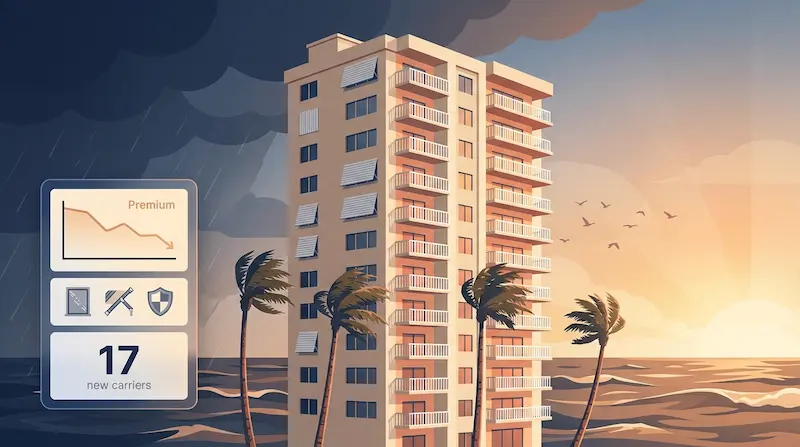
For five years, the only honest answer to "how do we lower our insurance premium?" was "you don't — you survive it." Six Florida property insurers were declared insolvent in 2022 alone (Southern Fidelity, Weston, Lighthouse, Avatar, St. Johns, FedNat), with Gulfstream falling the year before. The average Florida commercial condo association master policy went from $72,570 in mid-2022 to $147,381 in mid-2024 — a 103% cumulative increase across the 13,841 condo associations in the Florida Office of Insurance Regulation's dataset. Citizens Property Insurance ballooned to 1.41 million policies at its October 2023 peak. Boards levied $20,000 special assessments to plug coverage gaps. Carriers refused to bind without milestone inspections, structural integrity reserve studies (SIRS), and replacement-cost appraisals current within 12 months.
That market is over. In its place is something Florida associations have not had since 2019: optionality. Citizens has shed 76% of its policies, dropping to approximately 336,000 by March 4, 2026. The Florida Office of Insurance Regulation has approved 17 new property and casualty insurers since the December 2022 SB 2-A reforms — Stand Insurance Exchange and Praxis Reciprocal Exchange marked the 16th and 17th entrants in September 2025. American Coastal's Q1 2026 earnings release reported a 16.6% year-over-year decline in average Florida commercial property premiums — the first material rollover since the crisis began. The FIGA 1% emergency assessment is ending two years early on October 1, 2026.
This guide is for Florida condominium and HOA boards (and the CAMs who advise them) who are tired of insurance being the line item that takes annual budget growth hostage. Everything below reflects Florida statutes and Office of Insurance Regulation filings current as of May 2026. Each statutory citation links to the primary source. The strategies range from immediate (next-renewal procurement moves) to multi-year (hardening, SIRS-compliance posture). Most associations should be able to find 8-20% in renewal savings by working the first three steps alone.
The Florida market just flipped — here is what changed
Before listing tactics, the diagnostic matters: the market changed because the legislative inputs changed. Boards that understand why the market softened will make sharper procurement choices than boards reacting only to renewal quotes.
The four legislative inputs that drove the rollover
- SB 2-A (December 2022 special session) — eliminated one-way attorney fees, banned AOB on property claims, shortened claim-filing windows (2 years to 1 year new claims; 3 years to 18 months supplemental), reduced insurer payment windows from 90 to 60 days, and created the FORA reinsurance assistance program. Clyde & Co's analysis walks through each piece.
- HB 837 (March 2023) — civil-justice tort reform that reduced the litigation tail carriers were pricing into Florida property risk.
- Citizens depopulation acceleration — the Office of Insurance Regulation has approved nine carriers for depopulation cycles in 2026 alone. More than 546,000 policies were depopulated over the course of 2025.
- HB 1021 (condos) and HB 1203 (HOAs), July 2024 — not insurance bills themselves, but they tightened the milestone and SIRS compliance regime. Citizens is now prohibited from issuing or renewing policies for non-compliant associations, which is reshaping carrier-of-last-resort dynamics.
What the numbers say
OIR Commissioner Mike Yaworsky told reporters in April 2026 that Florida averaged a 0.8% rate increase over the prior two years versus 20-35% nationally, self-grading the market from an "F" to a "B." Twenty-seven companies filed for rate decreases in the first half of 2025; an additional 41 filed zero or no change. The 17 new entrants brought more than $574 million in new policyholder surplus to support additional growth, per the September 2025 OIR announcement.
None of this is uniform. Coastal high-rises with older roofs in Miami-Dade and Broward still face hard quotes. Inland HOAs with single-family parcels and modern construction are seeing renewal decreases of 8-15% without doing anything. The variable that determines which side of that line an association lands on is preparation. The next ten steps are how preparation looks in practice.

Step 1: Get out of Citizens — but only into the right carrier
Citizens was a lifeline in 2022-2023 when private capacity collapsed. In 2026 it is structurally different. Citizens' rate structure is statutorily capped (a glide path reaching 15% in 2026 for personal lines), but for commercial residential the carrier is actively recommending decreases. The 2026 Citizens multiperil filing approved an average 8.8% reduction effective July 1, 2026, with wind-only down 5.5%. Three out of five Citizens personal lines policyholders are receiving an average premium reduction of 11.5% (about $359 each). For commercial residential master policies, rate changes vary by risk and territory but are largely flat to down.
Citizens is also prohibited under recent statutory amendments from issuing or renewing policies for associations not in compliance with milestone inspection and SIRS requirements. The "last resort" pathway is narrowing.
The "20% rule" that traps boards
Citizens depopulation works through assumption offers from private carriers. Under current Florida depopulation rules, if an association receives a takeout offer from a private carrier within 20% of the Citizens premium, the association is generally required to accept the takeout (it cannot simply stay with Citizens at renewal). That sounds protective until you read the renewal data: Slide Insurance raised premiums an average 23.2% on Citizens takeouts at first renewal in 2024. Being depopulated is not the same as saving money.
The practical board move: do not wait for a depopulation offer. Solicit private-market quotes directly through a competent broker 90 days before renewal. If the private quote is cleanly below Citizens, take it on your terms. If the private quote is materially higher, decide whether you want to ride Citizens through one more cycle and harden the building in the meantime. The worst position is reacting to a takeout offer with no other quotes on the table.
Step 2: Bid the policy 90 days early through 2+ wholesalers
Florida association property risks are placed largely through wholesale brokers — intermediaries like RT Specialty, AmWINS, CRC Group, and Burns & Wilcox — who shop the risk across multiple carriers, including surplus lines markets that retail brokers cannot access directly. Most associations work with one retail broker, who works with one wholesaler, who shops a limited slate. That is not bidding; that is exclusive distribution disguised as procurement. Our Florida HOA insurance renewal playbook covers the full 90-day renewal calendar step by step.
What real bidding looks like
- 90 days before renewal: Issue a written submission package — current loss runs (5 years), updated replacement-cost appraisal, SIRS/milestone reports, roof inspection, wind mitigation report, board resolutions on hardening commitments, and a one-page underwriting narrative.
- Two-broker structure: Either appoint a second broker for the renewal cycle, or require the existing broker in writing to shop the risk through at least two named wholesalers. Document which markets were approached and the quotes (or declinations) received from each.
- Commission transparency: Require the broker to disclose all compensation in writing, including retail commission, wholesale commission, contingent commissions, and any "supplemental" or "profit-share" arrangements. The board cannot evaluate "broker advice" without knowing how the broker is paid.
- Net of commission option: For larger associations (typically $250K+ premium), ask carriers to quote both "as-filed" and "net of commission" with the association paying a separate, disclosed broker fee. This sometimes produces a lower total cost while making the broker compensation explicit.
- Bid-card discipline: Compare quotes on a like-for-like grid (TIV, deductibles, sublimits, ordinance & law, loss assessment, coinsurance terms, exclusions). Do not compare premiums in isolation.
Boards routinely save 10-15% by adding a second wholesaler to a renewal — not because the second wholesaler is smarter, but because the first wholesaler suddenly tries harder.
Try Mosaic alongside your current software. No Risk!
- Keep yourself compliant on every statute change
- Keep your board compliant across every workflow
- Keep your HOA compliant and your owners happy
Step 3: Finish SIRS and milestone before renewal
This is the single highest-leverage move available to most condo associations. Florida Statute 553.899 requires milestone inspections for condominium and cooperative buildings three stories or taller at age 30 (or age 25 for buildings within 3 miles of salt water). Our deep dives on the Florida condo milestone inspection and the structural integrity reserve study (SIRS) walk through both requirements in detail. The transitional deadlines are functionally past or imminent for nearly every covered building: associations whose buildings reached 30 years before July 1, 2022 had to complete their initial milestone inspection by December 31, 2024; buildings reaching 30 years between July 1, 2022 and December 31, 2024 must complete inspection by December 31, 2025.
Pair that with the structural integrity reserve study (SIRS) requirement under FS 718.112(2)(g), which mandates a SIRS for every condo building three stories or taller. Together they create a new underwriting prerequisite: in 2025-2026, most Florida property carriers want to see the milestone report, the SIRS, and a documented repair-funding plan before binding coverage on a master policy. Citizens is statutorily barred from binding non-compliant associations at all.
Why this is the leverage point
Underwriters assume the worst about associations that have not completed these studies. They price for unknown deferred maintenance, unknown structural issues, and an unknown special-assessment trajectory. An association that walks into a renewal with a completed milestone report showing no significant findings, a current SIRS with funded reserves, and board minutes documenting repair-plan execution materially changes the underwriter's risk picture. FPAT's 2026 Florida Condo Insurance Compliance Guide documents how carriers are now using SIRS quality as a binding gate.
The order of operations matters. Engage the engineering firm now (Phase 1 visual inspection is the first deliverable). Get the SIRS-aligned reserve study from a qualified provider. Pass formal board resolutions adopting any required repair plan. Submit all three with the renewal package. The premium impact often outweighs the inspection cost in the first year.
Step 4: Update your replacement-cost appraisal
Under FS 718.111(11), condominium associations are required to maintain adequate property insurance "based on the replacement cost of the property" and the replacement cost "must be determined at least once every 3 years." For HOAs, FS 720.3085 imposes parallel coverage obligations though the appraisal frequency is governed by carrier requirements rather than statute.
Why the appraisal sits at the center of the premium math
Property insurance premium is essentially (TIV × rate × modifiers). Total Insurable Value (TIV) is the replacement cost of the building. Two failure modes drive over-payment:
- Carrier-estimated TIV is almost always inflated. Carriers use reconstruction-cost estimators (e.g., MSB or e2Value) that tend to apply maximum coastal-construction premiums, conservative material assumptions, and inflated debris-removal allowances. An association accepting the carrier estimator without a competing independent appraisal often pays premium on 15-25% more TIV than the building actually requires.
- Coinsurance clauses penalize under-insured associations. Most Florida commercial property forms include an 80% or 90% coinsurance clause: if at the time of loss the policy limit is less than the stated percentage of replacement cost, the insurer pays only a proportional share of the claim. A current professionally prepared replacement-cost appraisal protects against this penalty.
The board move: budget for an independent insurance appraisal (commercial real estate appraisers and specialized "insurance appraisal" firms both do these) every 24-36 months. Submit it with the renewal package and require the broker to negotiate against it. The cost is typically $0.05-$0.15 per square foot for commercial residential; the savings on a properly-sized policy can be 10x that.
Step 5: Apply for My Safe Florida Condo when funded
The My Safe Florida Condominium Pilot Program was created by the 2024 Florida Legislature with $30 million in initial funding. It provides two distinct benefits to eligible associations:
- Free wind mitigation inspection. A licensed inspector identifies existing hurricane-resistant features and recommends upgrades that will qualify for insurance discounts.
- Matching grant up to $175,000 per association for wind mitigation improvements identified in the inspection — impact-rated windows, doors, roof straps and reinforcement, opening protection.
What the board needs to know
The program launched November 13, 2024 and effectively reached funding capacity within days. HB 393 (signed June 23, 2025) updated eligibility: buildings must be three stories or taller, be in compliance with milestone inspection and SIRS requirements, contain two or more occupied units, and the improvements must result in a wind-mitigation insurance credit. The Legislature did not appropriate new funding in 2025 — but the stricter eligibility is expected to disqualify many 2024 applicants and free up funding for compliant associations.
Eligible service area is associations within 15 miles of the coast. The board move: even with funding currently capped, submit the application for the free wind mitigation inspection now. If new funds are appropriated in the 2026 or 2027 sessions, applications already in the queue with completed inspections are first in line. The inspection alone, separate from any grant, often unlocks carrier-side credits worth more than the inspection cost.
Step 6: Harden the building strategically
Florida Statute 627.711 mandates that personal lines residential property insurers offer wind mitigation discounts — but the statute by its terms applies to personal lines only. For commercial residential master policies (condo association policies), there is no statutory discount floor. Wind mitigation credits on master policies are at carrier discretion and are typically tied to industry standards like the IBHS FORTIFIED Commercial program.
The features that consistently move the underwriting needle
- Impact-rated windows and doors meeting the Florida Building Code wind-borne debris region requirement. Replaces shutters as the durable solution; shutters require deployment, impact glass does not.
- Hip roof geometry (versus gable). Aerodynamically more resistant; carriers price the difference. Cannot be retrofitted economically, but matters at acquisition.
- Secondary water barrier — a self-adhering membrane installed under the roof covering. Cheap during a re-roof; produces underwriting credit.
- Roof-to-wall connections with hurricane straps or clips rated for the design wind speed. Retrofit possible during re-roof.
- Roof age and condition. Roofs over 15-20 years are an underwriting flag regardless of remaining useful life. HB 1183 (2022) created protections against nonrenewal solely on roof age for personal lines, but those protections do not extend to commercial residential master policies. A board planning a 7-figure renewal cycle should price out the trade-off between a re-roof and three more years of inflated premium.
Stacking impact windows, hip roof geometry, hurricane straps, and a secondary water barrier under the FORTIFIED Commercial framework can move the wind portion of an association's premium 25-45%, depending on carrier. The trade-off is upfront cost — a special assessment to harden the building is often easier to pass when board members can model the post-hardening insurance savings on a 5- or 10-year horizon.
Step 7: Right-size the hurricane deductible
Hurricane deductibles in Florida are expressed as a percentage of the policy's stated insured value. For personal lines, FS 627.701 mandates carriers offer $500, 2%, 5%, and 10% options (with 3% substituting for 2% on dwellings $1M-$3M). For commercial residential master policies, the structure is similar but the percentage choices are made at the negotiation table, not by statute. Typical condo association master policies offer 3%, 5%, or 10% named-storm deductible options. The deductible math matters most after a storm — our post-hurricane insurance claim playbook shows how a master-policy deductible gets passed through to unit owners.
The deductible math worked out
On a $10 million building, the math is concrete:
- 3% deductible = $300,000 per named storm. Lower out-of-pocket if a storm hits; higher premium.
- 5% deductible = $500,000 per named storm. Moderate premium savings (commonly 8-15% versus 3%).
- 10% deductible = $1,000,000 per named storm. Largest premium savings (commonly 18-30% versus 3%), but the association assumes a substantial first-loss position.
The deductible is functionally an exposure the association passes through to unit owners via loss-assessment coverage on their HO-6 policies — but most HO-6 policies cap loss-assessment coverage at $2,000 default. An association that runs a 10% named-storm deductible on a $10M building has a $1M loss-assessment exposure spread across (say) 100 units = $10,000 per unit. Most unit owners are not insured for that. The board move: model the deductible scenarios, communicate with owners in advance about the implied loss-assessment exposure, and either pair a higher deductible with a member-funded hurricane reserve or stay with a lower deductible until owners have time to layer up their HO-6 loss-assessment limits.
Step 8: Audit every coverage line, not just property
Property is the largest line item but it is not the only one. Several coverages routinely get under-priced, over-priced, or missed entirely.
The lines to inventory annually
- General Liability (GL): Separate from property. The Surfside Champlain Towers South tragedy underscored the cost of inadequate GL — the building reportedly carried $30M in property insurance from Great American and $18M in liability coverage, $48M combined, against an event with 98 fatalities. The plaintiffs' counsel called the coverage "obviously inadequate." Board liability limits for buildings with significant public-area exposure (pools, lobbies, parking decks) should be benchmarked against peer associations, not selected by inertia.
- Directors & Officers (D&O): Not statutorily mandated but functionally essential. Covers board members against claims arising from governance decisions. Check whether the policy includes "insured-vs-insured" exclusions and whether it covers regulatory investigations (DBPR enforcement actions).
- Fidelity / Crime bond: Required for Florida condominiums under FS 718.111(11)(h). The bond must cover "the maximum funds that will be in the custody of the association or its management agent at any one time." For condos, this requirement cannot be waived. For HOAs, FS 720.3033(7) permits a member waiver but requires affirmative annual member action. Most boards under-insure here because the policy is cheap and the requirement is obscure — until an embezzlement triggers a claim larger than the bond.
- Cyber liability: Emerging best practice. Covers ransomware response, owner-data breach notification, and business interruption from a cyberattack on the management agent's systems. Premium ranges from $1,200 to $8,000 annually depending on association size and existing controls.
- Equipment breakdown (boiler & machinery): Coverage for mechanical or electrical breakdown of HVAC, elevators, generators, pool equipment. Frequently a sublimit on the master property policy rather than a separate line. Verify the sublimit is enough for actual equipment values; doubling it is usually inexpensive.
- Workers compensation: Required if the association has any W-2 employees (rare, but applies to associations that employ on-site security, maintenance, or front-desk staff directly rather than through a management contractor).
The audit move: at the start of each renewal cycle, list every coverage line the association currently buys, the limit, the deductible, and the annual premium. Compare year-over-year. Ask the broker to recommend three changes (up or down) with rationale. Then decide as a board.
Step 9: Know what is surplus lines (and what FIGA will not cover)
Florida property insurance is sold in two channels: admitted (carriers licensed by Florida, regulated rates, protected by FIGA) and surplus lines (non-admitted carriers, freer pricing and forms, NOT protected by FIGA). For condo associations and HOAs, particularly larger or coastal risks, surplus lines is often the only available market for the catastrophe-exposed portion of the coverage.
What the statute requires
Under FS 626.916, surplus lines placement is only allowed after a diligent effort to find the same coverage in the admitted market. More importantly, the insured must sign or document acknowledgment of a specific FIGA disclosure: "Coverage may be available in the admitted market. Persons insured by surplus lines carriers are not protected under the Florida Insurance Guaranty Act with respect to any right of recovery for the obligation of an insolvent unlicensed insurer."
Why this matters now
The Florida Insurance Guaranty Association (FIGA) has paid more than $2.1 billion in claims over the last five years across the wave of insolvencies. If an association's master policy or wind layer is in the surplus lines market and that carrier becomes insolvent, the association has no FIGA backstop. The board move is not necessarily to refuse surplus lines coverage — sometimes there is no admitted alternative — but to require the broker to disclose in writing:
- Which quotes are admitted versus surplus lines
- The financial strength rating of each surplus lines carrier (AM Best or Demotech)
- The carrier's domicile and the strength of any reinsurance backstop
- The premium differential between an admitted (if any) and surplus lines option
Then price the FIGA-protection differential explicitly. A 10% premium savings on a surplus lines policy is not actually savings if the carrier is structurally weaker. The cheapest quote is not always the right quote.
Step 10: Document risk management for underwriting credit
Underwriters write what they can see. A board that runs the association well but cannot document it leaves underwriting credit on the table. Documentation is the cheapest premium-reduction strategy available.
What underwriters actually look at
- Five-year loss runs with claim narratives explaining each incident and any corrective action. A clean loss run is the single strongest pricing signal.
- Written risk-management plan — even a 2-page board document covering water intrusion response, fire watch procedures during alarm-system outages, pool/spa maintenance, life-safety inspection logs.
- Water sensor and shut-off documentation — smart water detection systems (Moen Flo, WaterCop, MoistureLink) in mechanical rooms and on washing-machine connections can earn carrier credits and dramatically reduce one of the most common condo loss categories.
- Vendor insurance certificates on file for every contractor doing work on common property — landscapers, pool services, roofers, painters. Documents that risk is being transferred rather than absorbed.
- Board minutes documenting safety actions — pool gate repairs, walkway repaving, lighting upgrades. The minutes become evidence in any future liability claim and also signal active risk management to underwriters.
- Fire alarm and sprinkler inspection records — required for code compliance anyway; documenting submission produces credit.
- Roof inspection report — even outside of milestone, a roofing contractor's recent inspection report extends carrier comfort and reduces premium add-ons for "uncertain roof condition."
None of this is exotic. It is the same risk management most well-run boards already do; the difference is whether anyone has organized it into a submission packet the broker can hand to the underwriter.

How Mosaic helps boards work this list
Most of the savings in this guide sit behind paperwork. A renewal cycle has 10-15 documents that need to be current, organized, and delivered to the broker on time. Boards that win their renewal almost always have a system; boards that lose ground at renewal almost always have a stack of emails. Mosaic is the system.
Renewal calendaring: Mosaic tracks the renewal date for the master policy, GL, D&O, fidelity bond, cyber, and equipment breakdown lines separately, alerts the board treasurer 120 days before each one, and shows the procurement workflow status in plain sight.
Compliance posture: SIRS completion date, milestone inspection report, replacement-cost appraisal date, last roof inspection, board resolutions on repair plans — all linked, dated, and ready to ship to a wholesaler in a single PDF packet on demand. The treasurer does not chase a property manager for three days to assemble the renewal submission.
Owner communication: when the board adopts a 5% versus 10% named-storm deductible, Mosaic drafts the plain-English notice to owners explaining the loss-assessment implications and reminding them to layer up their HO-6 limits. The complaints that show up at the next board meeting are about the decision, not about communication.
Vendor and broker records: certificates of insurance, broker commission disclosures, wholesale market submissions, and quote comparisons live in one searchable archive. Three years later, when a board member asks "did we actually shop the policy in 2025?", the answer takes 30 seconds, not three days.
Mosaic does not replace the broker. A good broker is irreplaceable. Mosaic replaces the disorganization that costs boards 5-15% at every renewal because nobody had the documents ready when the underwriter asked.
Key takeaways
- The Florida market just rolled over. Citizens cut homeowners multiperil rates 8.8% effective July 1, 2026. American Coastal — the largest Florida condo association carrier — reported Florida commercial property premiums down 16.6% year-over-year through Q1 2026. 17 new property insurers have entered since the 2022-2023 reforms.
- Savings are not automatic. Boards that simply renew with the incumbent at the offered rate often miss the new market entirely. Procurement discipline (bid 90 days early through 2+ wholesalers, demand commission transparency) typically produces 10-15% on its own.
- Milestone and SIRS compliance is the highest-leverage underwriting move. Citizens is statutorily barred from binding non-compliant associations. Private carriers price for uncertainty when associations cannot produce the milestone report and current SIRS.
- The replacement-cost appraisal is required every 3 years under FS 718.111(11) for condos — but carrier estimators routinely inflate TIV by 15-25%. An independent appraisal pays for itself the first cycle.
- Surplus lines is not covered by FIGA. FIGA has paid $2.1B in claims over five years across seven major insolvencies. Boards should require written disclosure of admitted versus surplus lines status, carrier ratings, and the FIGA-protection differential.
Frequently asked questions
Share this guide